
By Dan · September 14, 2025
Apple Watch Is Enough
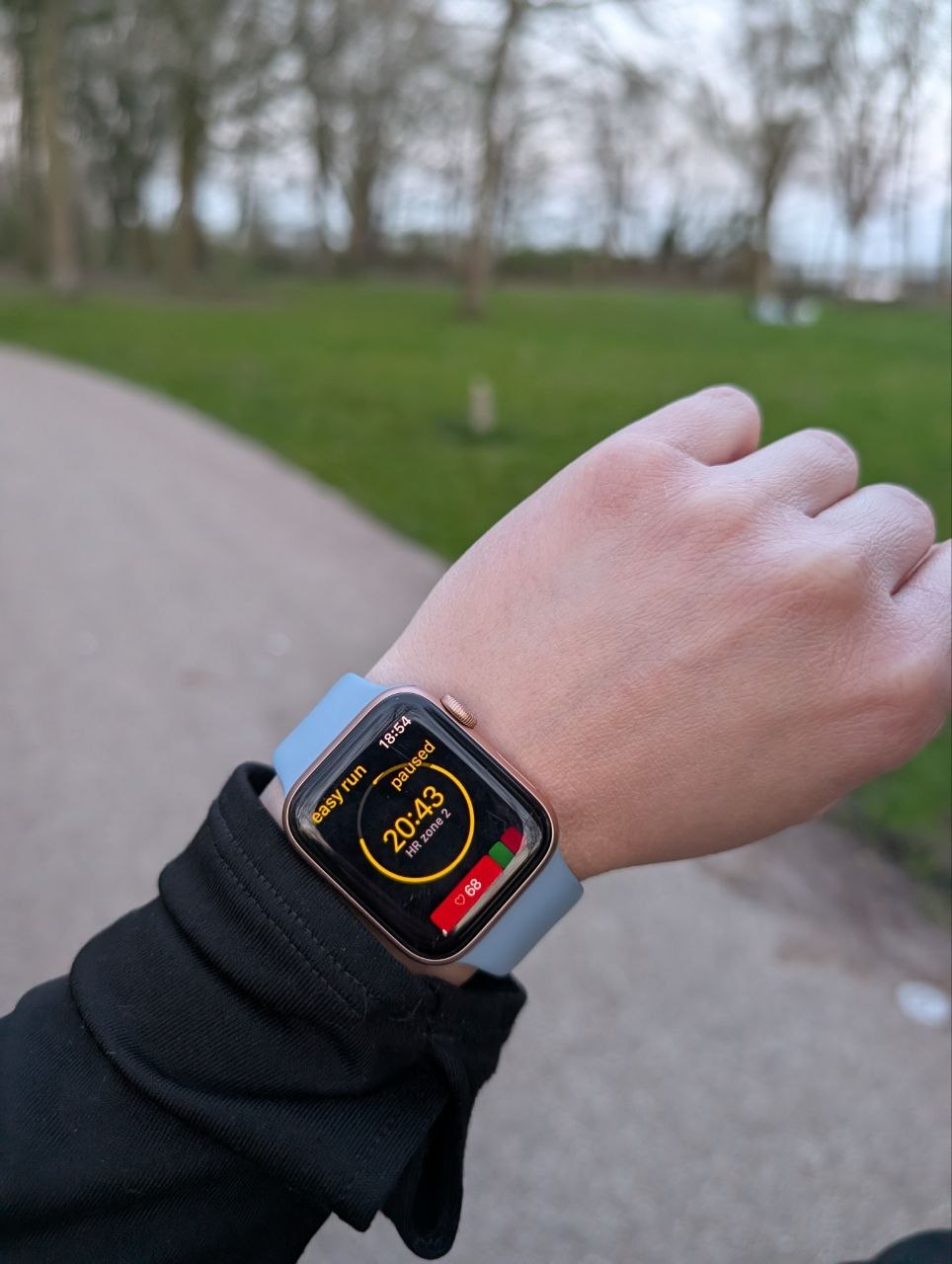
One question, before anything else:
Do I want to think about my phone when I’m running?
If your answer is no, we’re building toward you. We’re not all the way there. This is less a manifesto than a status report — what we wanted, what we ran into, and where we’re actually headed.
What we set out to build
The original idea was pure: a running app that lives on your wrist. Set up a plan once, then never need the phone again. Walk out the door with just the watch. Start the run from the watch. The plan, today’s workout, the intervals, the history — all of it on the watch. The phone optional. Ideally forgotten.
We loved that idea. It’s why we started.
The Apple Watch as the whole running computer. The iPhone as the thing you only touch when you’re planning.
That was the north star.
What actually happened
It was harder than we thought — and somewhere in the middle of it we understood why nobody else ships it that way.
- Planning is a seated, detailed activity. Picking a race date, a weekly schedule, a level, then shuffling workouts around real life — that’s a lot of interface. On a 45mm screen it’s miserable. The phone is genuinely the better tool for the planning half.
- The boundary between the two devices is the fragile part. Getting plan changes to agree across iPhone and Watch, reliably, is most of the work. The more we made the watch the source of truth, the more there was to break. (We’ve got a whole separate war story about that.)
- We’re two people. Building rich plan-editing twice — once per device — is an enormous amount of work for a payoff most runners never asked for.
So we did the pragmatic thing. Today Run Plan has roughly the shape you already know: you plan on the phone, you run on the watch. Set up training on the iPhone; the watch carries the workouts and runs them on its own — no phone needed for the run itself.
We’re not going to dress that up as a reinvention. It’s the same basic split Strava, Nike Run Club, and Runna landed on, for the same reasons we did.
Why we still believe in the wrist
Landing in the common shape didn’t change what we believe: for the part that actually matters — the run — the watch is enough.
An Apple Watch SE 2 (what we develop on) can, on its own, track GPS, read heart rate, run a structured workout — intervals, audio cues, haptics — drive Bluetooth headphones, and save everything to HealthKit. For a 30-to-90-minute training run, that’s the whole job. You don’t need the phone on the run, and our watch app is built so you don’t carry one.
And even with setup living on the phone, we still design the run for the wrist first. That’s the piece of “watch-first” we kept:
- Brutal hierarchy. You get two or three seconds of attention per glance — sweaty, breathing hard, maybe sunglasses. One number matters most, one secondary, maybe a third. Everything else is cut. (Primary: elapsed time + current interval target. Secondary: heart rate, pace. Swipe for splits and the next interval.)
- Animation has to earn its battery. A pretty 30 Hz pulse looks great in a mockup; sustained over two hours it costs CPU and main-thread time the rest of the UI needs. So almost everything is static or fires only on event boundaries. Elapsed time and the heartbeat animate — throttled.
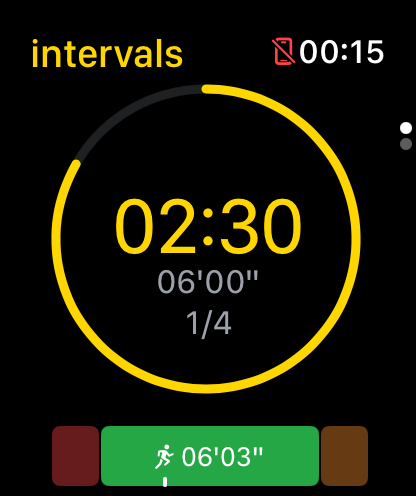
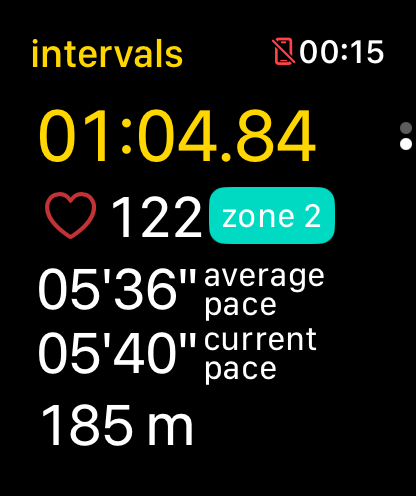
The layers in practice. Glance down mid-rep and you get one number and the target. Swipe once and the full picture is there — heart rate, zone, pace, distance — for when you actually want it.
Where we’re going
The dream didn’t die, it just got a timeline. We want Run Plan to get more watch-centered over time, not less — moving back toward the original idea one payoff-first step at a time:
- More of the “what should I do today” decision living on the wrist, so the phone matters even less day to day.
- Eventually, enough plan awareness on the watch that a phone-free training week is the normal case, not a special trick.
We’d rather ship the pragmatic version that works now and grow it than ship the pure version that doesn’t.
Caveats
- SE 2 GPS is single-frequency. Under tree cover or between tall buildings the current-pace number wanders. Splits hold up; the second-by-second wobble is real, and we’ve spent more evenings on it than we’d like to admit.
- Long runs eat battery. Roughly 60% for a four-hour GPS run on SE 2. Fine for marathon training; not fine for 100K ultras.
- You can always bring the phone. Watch-first as a value doesn’t mean phone-forbidden. Bring it, leave it in your pocket — the watch still does the work, and you happen to have a phone if you need one.
- This ties us to Apple. No Android, no web. Fewer users, more focus. A trade-off we keep choosing.
The takeaway
“Apple Watch is enough” is a belief and a direction, not a finished boast. We tried to build the pure version, learned why it’s hard, and shipped the pragmatic one — plan on the phone, run on the wrist. We kept the wrist-first discipline where it counts, and we’re aiming, slowly, back at where we started.
If your answer to that first question is still no — that’s the runner we’re building for.
Run Plan is an indie iOS + Apple Watch training planner built by a 2-person team in Amsterdam. No accounts, no ads, no subscription. Your data stays on your device.