
By Dan · June 7, 2026
Introducing the Pro Plan
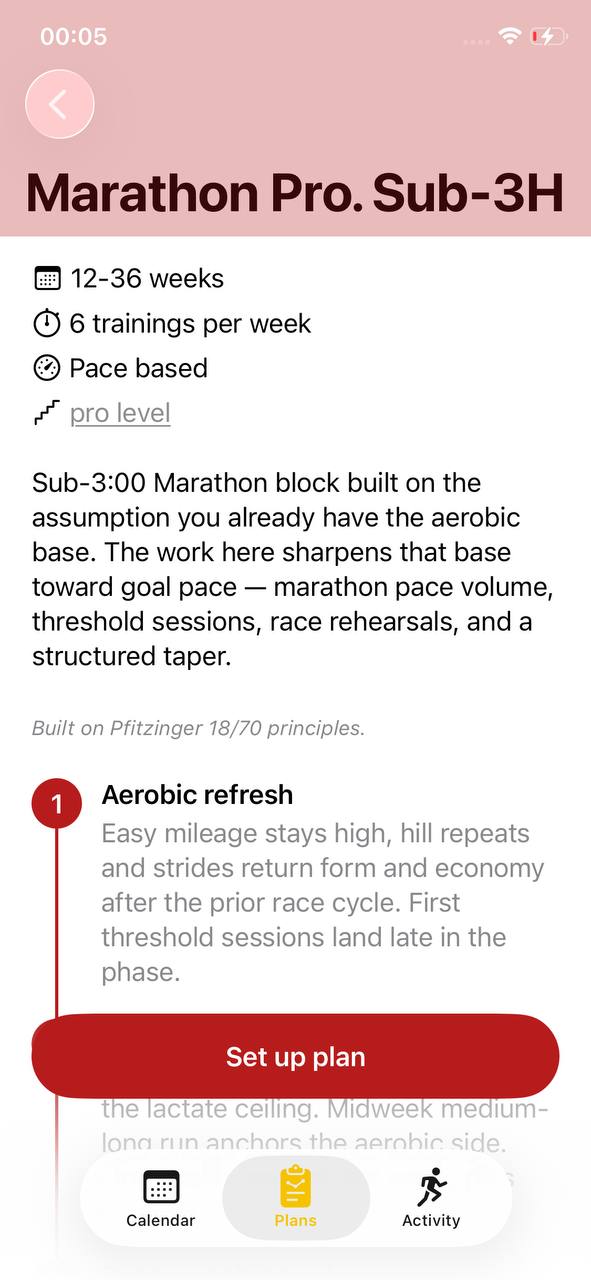
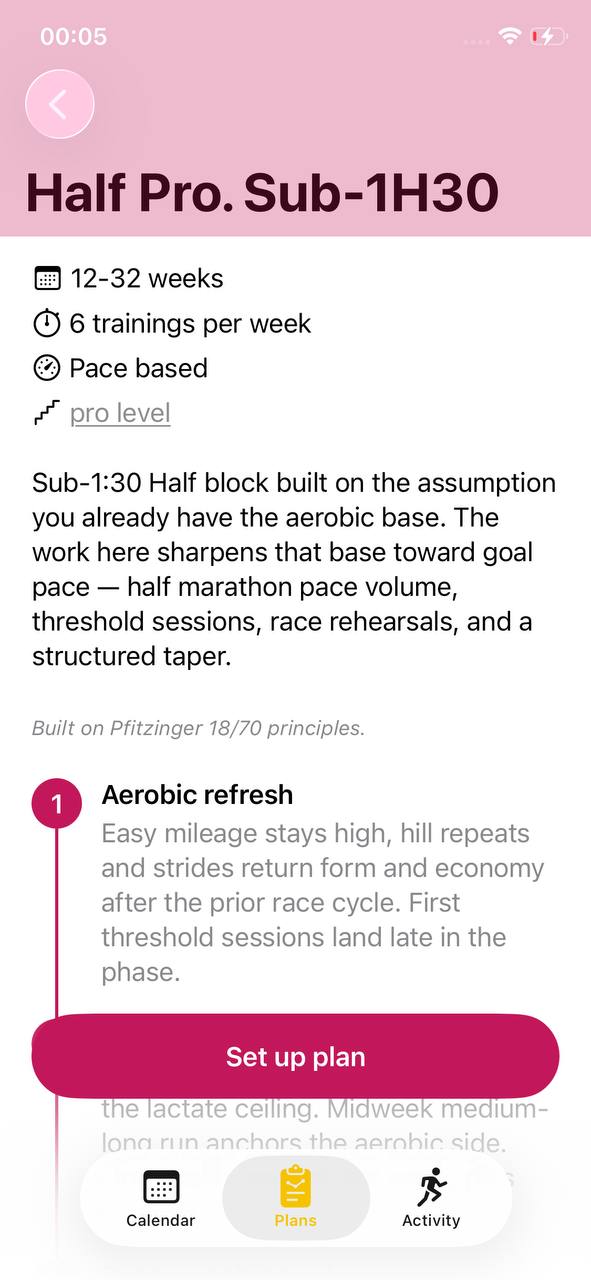
We’ve added a new tier to RunPlan. Pro — sub-3:00 marathon and sub-1:30 half. Until this week neither distance had a Pro-level plan; runners aiming for those times were using the Advanced non-competitive plans, which are built for a different runner.
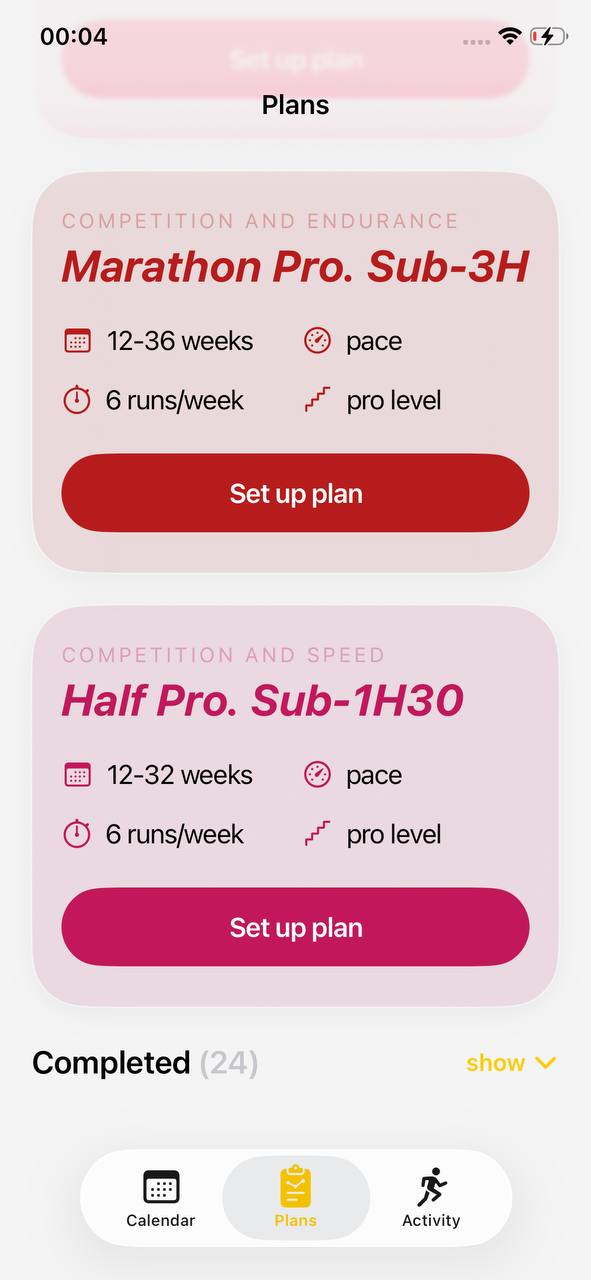
The motivation was specific. The Advanced plan covers what most amateur runners are reaching for: five training days a week, a structured build to peak, a sensible taper, race rehearsals at the goal pace. It works well for somebody chasing a 3:30 marathon or a 1:45 half. It does not work well for somebody chasing sub-3:00. The goal pace is too fast for the catalogue’s marathon-pace workouts to align cleanly. Weekly volume is below what serious sub-3 training demands. The threshold work is too short. The peak block doesn’t hit deep enough.
The Pro tier exists to fill that gap.
Who Pro is for
A runner who has raced a marathon under 3:20 recently, or a half under 1:35. That’s the fitness floor below which Pro-level training becomes too aggressive — too much weekly mileage, too many quality sessions, too compressed a build. Below the floor we route the runner to a non-competitive plan instead. The Pro plan refuses to build if our fitness estimate places them too far from goal — we’ll come back to that.
What the runner enters
Two fields. Race date, and a recent race — distance plus time.
We don’t ask the runner what level they are, how many days per week they want, or what their goal pace is. Pro is fixed at six training days per week, three quality sessions through peak. The goal pace is the qualifying time for the tier (sub-3:00 marathon, sub-1:30 half). The only thing we need from the runner is the starting point.
Estimating fitness
From the recent race we compute the runner’s VDOT — Jack Daniels’ single-number representation of aerobic fitness, derived from a single race result. A VDOT of 58 predicts roughly a 3:00 marathon, a 1:25 half, a 38:00 10K, an 18:20 5K. The relationship is empirical: Daniels fitted it to thousands of race results across decades of coaching, and it’s documented in Running Formula.
The formula is a ratio. The numerator is the estimated oxygen cost of running at the race velocity. The denominator is the fraction of V̇O₂ max sustainable for the race duration — short races allow a higher fraction, long races a lower one. For a race covering distance in time , with velocity in m/min and in minutes:
The seven-digit constants are Daniels’ fit to his metabolic-cost data, not typos. The numerator is a quadratic in velocity that estimates oxygen cost in mL/kg/min. The double exponential in the denominator captures two physiological time scales — the slow term () governs long races, the fast term () governs short ones, and the floor is the fraction of V̇O₂ max sustainable for arbitrarily long efforts. For a marathon only the slow term matters; for a 5K both contribute.
Plug in a 10K (10000m) in 41:00 (41 minutes, velocity 243.9 m/min) and it returns roughly VDOT 52. The same VDOT 52 then predicts about a 19:35 5K, a 1:33 half, a 3:15 marathon — the rest of the runner’s race-time curve falls out of the same equation, run backwards.
What the number actually represents is three things at once. First, V̇O₂ max — the maximum rate at which the runner’s body can transport and use oxygen, measured in millilitres per kilogram per minute. Second, running economy — how much of that oxygen budget gets spent per metre of forward progress, which depends on biomechanics, neuromuscular efficiency, and lower-leg stiffness. Third, the fractional utilisation of V̇O₂ max the runner can hold for the duration of a given race (a marathon is run at about 80-85% of V̇O₂ max for a trained amateur, a 5K at about 95%). VDOT collapses all three into one comparable number.
We use it for two things. First, training paces — every easy run, every threshold tempo, every interval pace is computed from the runner’s current VDOT, not from the goal time. A runner currently fit for a 3:08 marathon who wants a sub-3 plan has threshold paces calibrated for the 3:08 runner. Those paces tighten as the plan progresses; by race week they’re at goal levels because the runner has actually reached that fitness. Plans that anchor paces to the goal instead of the current state ask the runner to train at a pace they can’t yet hold, and they break in week three.
Second, the projection of where the runner will land at race day, which decides whether the plan is allowed to build.
VDOT itself never appears as a number the runner sees. Everywhere it shows up as paces, durations, or HR zones. They don’t need to know their VDOT to follow the plan. They need to know what they’re running on Tuesday.
The workout pool
The Pro plan draws from a catalogue we’ve built up across two years of audits. The peak block rotates through a wide enough set of sessions that no two weeks look the same, and no hard workout type repeats inside a three-week window.
Threshold work — the lactate-accumulation boundary session, in one of two formats. Either cruise intervals (three to six repeats of one mile at threshold pace, two to three minutes recovery) or a continuous tempo (twenty to forty minutes unbroken at threshold pace). Same physiological target — raising the pace at which lactate starts to accumulate — different psychological challenge. The catalogue rotates between formats so the runner doesn’t see the same shape every week.
VO2 work — Yasso 800s once per peak cycle as a benchmark (ten 800m repeats at marathon-time-as-minutes-seconds), and mile-pace repeats with short recovery on the other VO2 days. Bart Yasso’s claim that average 800 time predicts marathon finish is folklore that doesn’t survive statistical scrutiny, but the workout itself is honest VO2 work and a useful fitness check.
Hill repeats — eight to twelve short hills, focused on form and leg strength. BASE and early SPEED lean on these as the strength-component of the plan; they show up less in PEAK because race-pace specificity matters more by then.
Marathon-pace rehearsals — long runs with a substantial chunk at marathon pace embedded. The MP block climbs a ladder across PEAK: 60 minutes, then 70, then 90 — the last one inside a ~160-minute long run about four weeks before race day. The defining workout of the marathon block.
Progressive long runs — start easy, finish at marathon pace. A bridge from BASE’s pure aerobic long runs to PEAK’s full race rehearsals, easing the runner into running fast at the end of a long effort rather than fresh.
Strides — eight by twenty seconds at fast pace, full recovery. Neuromuscular maintenance with no recovery cost. Used the day before quality sessions or before a long run.
Phases and transitions
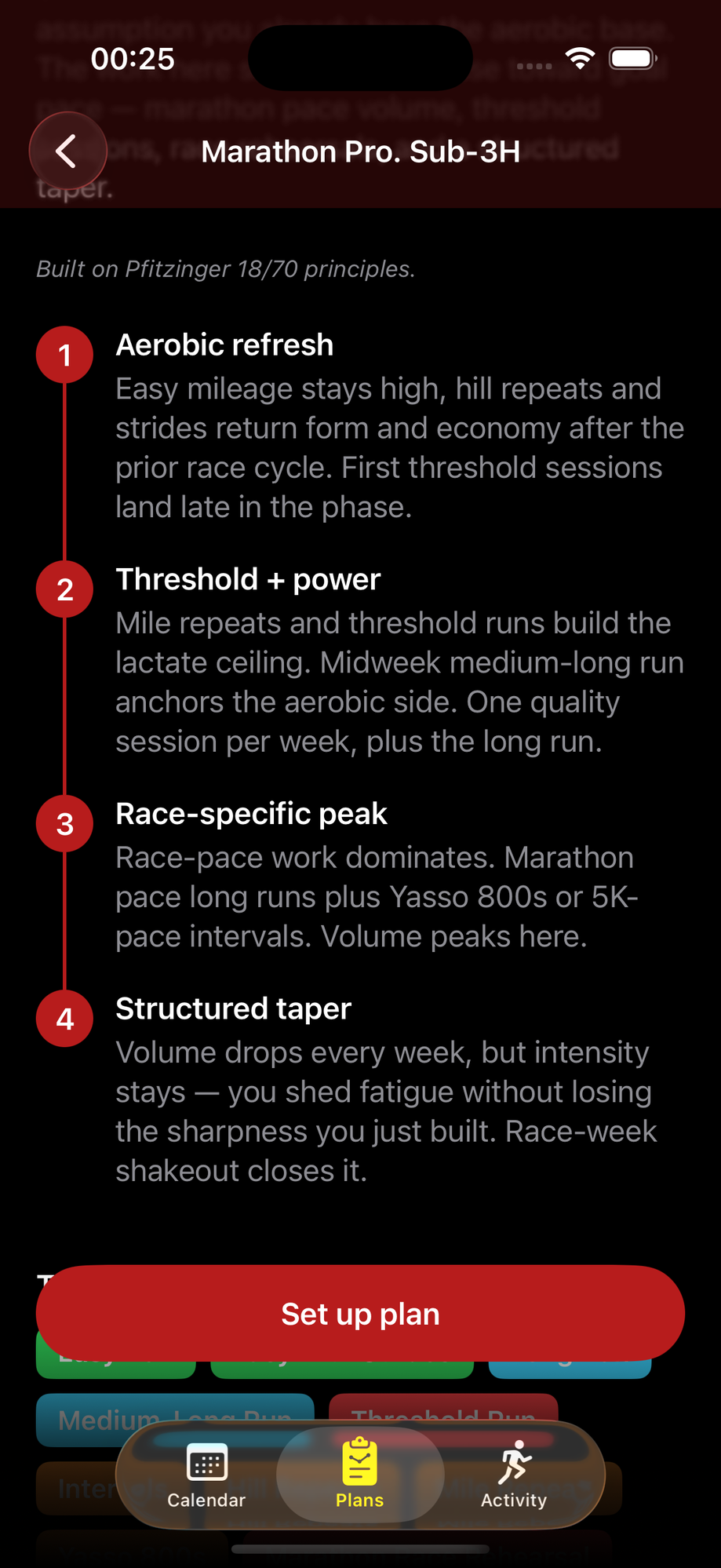
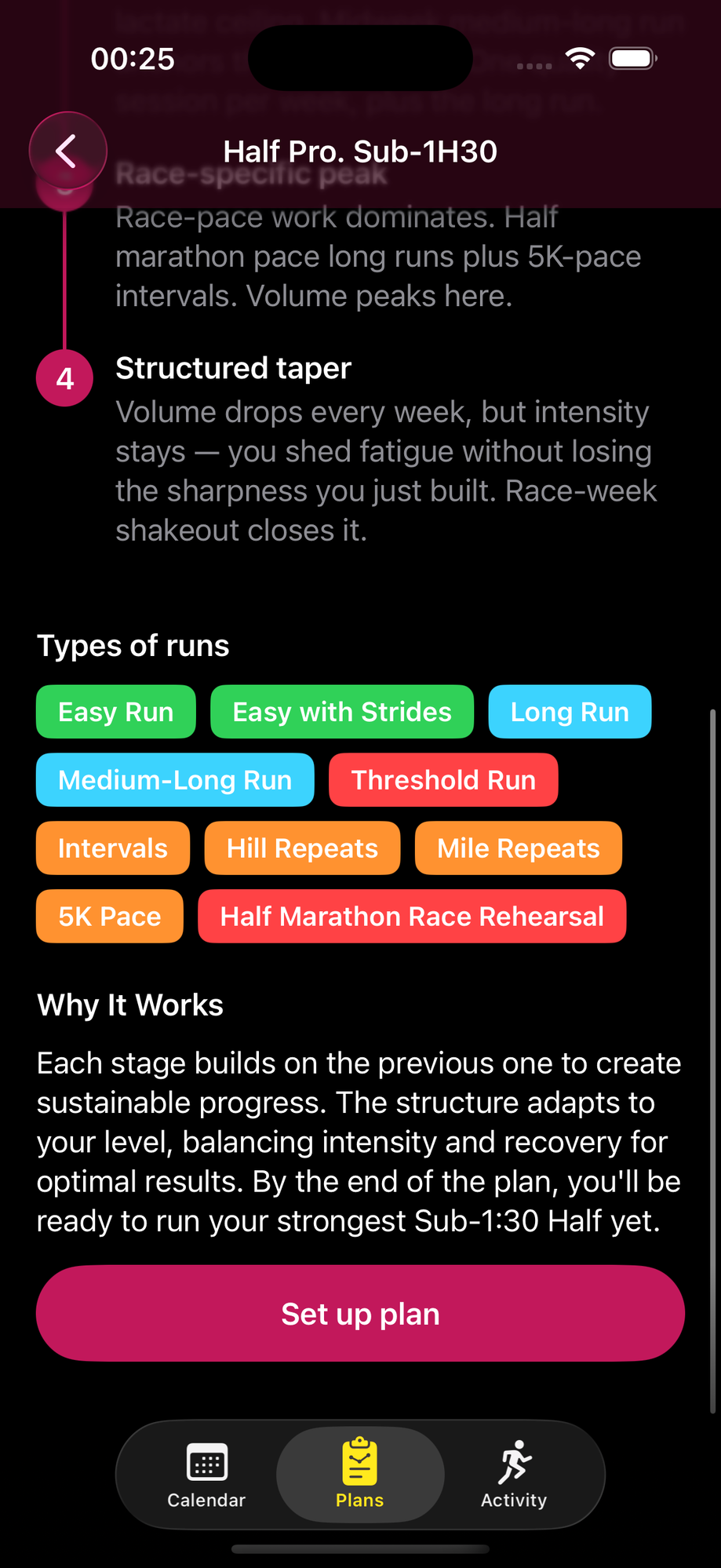
Four phases: BASE → SPEED → PEAK → TAPER.
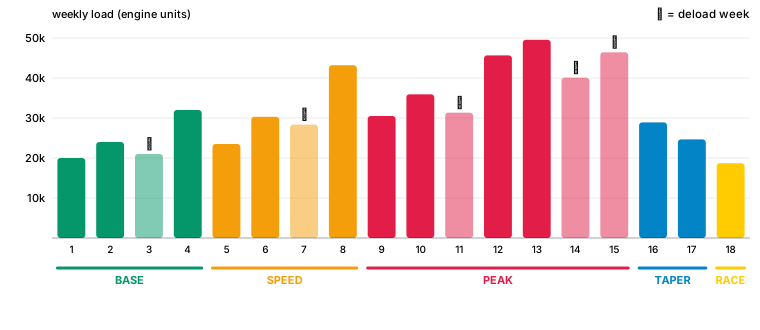
A 12-week Pro marathon plan runs roughly BASE×2 / SPEED×3 / PEAK×4 / TAPER×3. An 18-week plan stretches to BASE×4 / SPEED×4 / PEAK×7 / TAPER×3. A 24-week plan adds more BASE still — seven weeks of pure aerobic work before any interval session shows up.
Transitions are where plans break runners. Going from all-easy to three quality sessions in one week is the textbook way to injure someone. We feather it. Last BASE week has one introductory threshold session — same shape as the SPEED-week version, half the volume. Last SPEED week has a marathon-pace segment inside the long run — the seed of the PEAK race rehearsal. Body never meets a workout cold.
The same applies to volume. Weekly mileage doesn’t jump between phases; it slopes up across the plan. It cuts back every third week — by a full 25% in Pro plans, because at this volume a small dip isn’t recovery — and the long run cuts back with it, about twenty percent, swapped to plain aerobic. Then everything drops cleanly in TAPER. Outside those scheduled dips the long run only climbs — no build week has a shorter long run than the one before. That sounds obvious. It catches the most generation errors.
Within a week
Six training days. Tuesday and Friday are the quality days through PEAK. Wednesday is the medium-long run, sixty to ninety minutes, easy. Monday and Thursday are recovery. Saturday is easy with strides. Sunday is the long run — around two hours forty by peak; we cap it there, because past that point a long run costs more than it builds.
We never put two hard days back-to-back. We never put a hard day the day after a long run. If race week or holidays force a conflict, we move the easy days, never the quality ones.
Across the whole plan
The long run progresses from roughly twenty kilometres in week one of BASE to a capped thirty-four in PEAK. The build weeks of PEAK carry the race rehearsals; the down weeks deliberately don’t — a recovery week’s long run is plain aerobic, about twenty percent shorter than the week before. A rehearsal never lands on a down week.
Quality-session count escalates with phase. BASE has one per week, usually a threshold cruise kept short. SPEED has two. PEAK has three. Recovery weeks happen every third week within a phase — volume drops roughly twenty-five percent and the heaviest quality session comes out. The body adapts during recovery; the recovery week is when the previous three weeks’ work converts into fitness. Skipping it is the most common amateur mistake. We hard-code it.
Foundation weeks
If the runner has more weeks until race day than the structured build needs, the surplus goes into BASE. The extra weeks are pure aerobic — no quality, slowly rising volume. Mitochondrial density, capillary growth, slow-twitch durability all benefit from sustained easy mileage in a way that quality sessions don’t. By the time SPEED starts, the runner has a deeper foundation, and the quality work hits a more resilient runner.
If the runner is already close to goal, we compress BASE and leave them sitting longer in SPEED and PEAK. There’s a ceiling on what any single training cycle can extract; pushing more volume on an already-fit runner doesn’t extract more, it adds injury risk.
The projection (and the gate)
The same estimate gates plan creation.
We model the runner’s expected race-day VDOT as their current VDOT plus a per-block adaptation gain. Three numbers go into the gain — the per-week growth rate, the adaptation ceiling, and how the gain accumulates toward that ceiling over the plan length. Each is empirical, calibrated against observed cycle outcomes from coached groups following Daniels, Pfitzinger, and Higdon programs.
The per-week growth rate is derived from the actual plan structure, not picked. Aerobic gain comes from weekly mileage, quality gain comes from the count of threshold / VO2 / MP sessions per week, and there’s a small newness boost at low starting VDOT (untrained-to-trained adaptations front-load, so a beginner gets more out of the same stimulus than a trained runner does):
— average weekly miles. — quality sessions per week. — current VDOT. ramps from 1.0 (at VDOT 38 and above) to 1.2 (at VDOT 30). The two constants (0.005, 0.04) were fitted against the Intermediate 10K profile — 35 mi/wk, 2 quality sessions — landing at ~0.255 VDOT/week, which matches Daniels’ “1 VDOT per 4 weeks” rule of thumb for a trained runner at moderate volume. Higher-stimulus plans gain faster; lighter ones slower.
The adaptation ceiling is the maximum total VDOT gain we project for this cycle. It scales with two things: the plan’s level (Pro has the highest stimulus, beginner plans the lowest), and how close the runner already sits to their genetic ceiling. Decay is super-linear so the ceiling collapses faster as VDOT rises, matching what coached groups actually see at the top end:
— the level’s base ceiling (8 for Pro). The floor of 0.10 means even a runner approaching the genetic ceiling (VDOT 65 and up) can still project a small per-cycle gain. The exponent 1.5 is the curve we settled on after trying linear (too generous to advanced runners), quadratic (too pessimistic on cycle-over-cycle progression for serious sub-3 chasers), and several values in between.
Gain itself is asymptotic, not hard-capped. A simple would saturate the moment hit and produce identical projections for 12-week and 24-week plans — broken UX, and wrong physiology. The asymptotic shape guarantees monotonicity in weeks and matches the diminishing-returns curve of real adaptation:
— plan weeks. At low stimulus () the formula is approximately linear in ; at high stimulus () it asymptotes toward . A 24-week plan always projects more than a 12-week plan from the same starting point, and the difference shrinks as either approaches the ceiling.
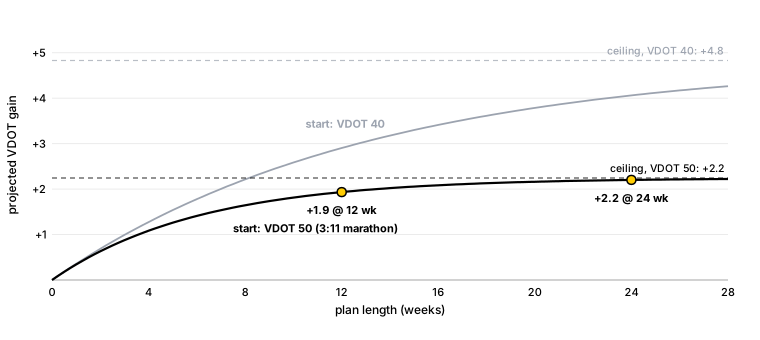
The numbers are deliberately conservative. A runner currently at a 3:11 marathon (VDOT 50) doing an 18-week Pro plan projects to land at roughly a 3:05 finish, not sub-3:00. The model errs on the under-promise side so the gate doesn’t pass a runner who’s going to come up short on race day.
If the projection falls within five minutes of the goal — 3:05 for the sub-3 marathon, 1:35 for the sub-1:30 half — the plan is allowed to build. Five minutes is the band where a focused taper, decent race-day weather, and clean pacing can plausibly close the gap.
If the projection misses by more than five minutes, the plan refuses to build. A red banner explains why and points the runner at the regular Advanced marathon plan, which is built for exactly their projected pace. The create button is disabled.
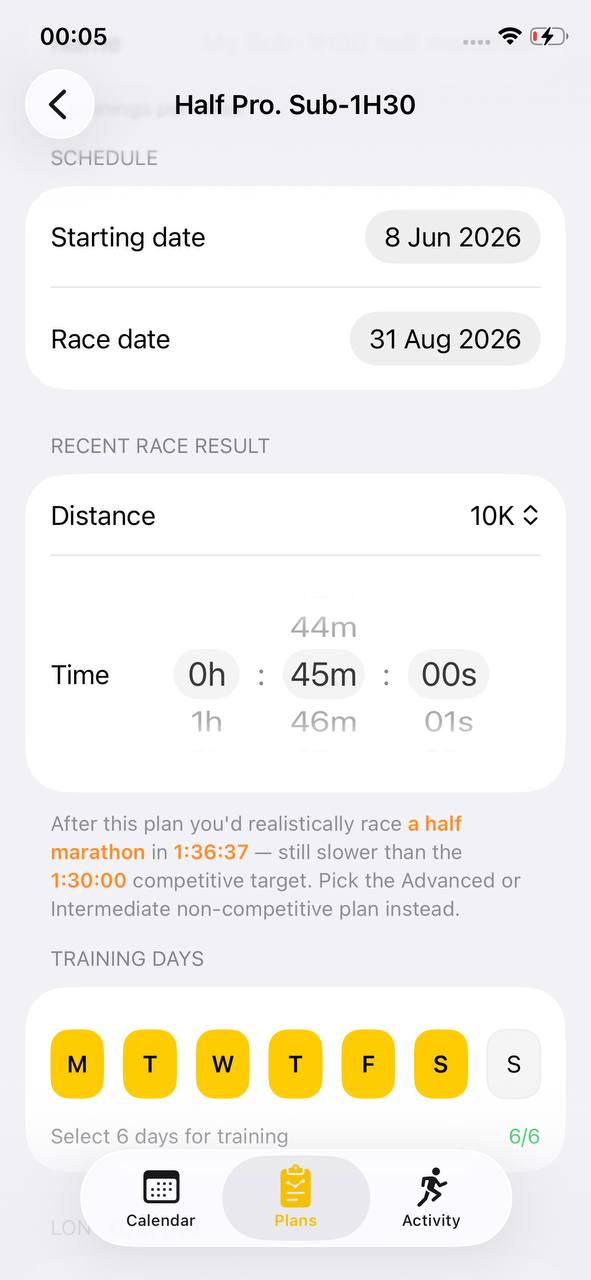

Most run apps will sell you any plan you ask for. We didn’t want to be most run apps. The runner who comes to us for a sub-3 plan and gets told “your projection says 3:08, do the Advanced plan first” leaves with better information than the runner who gets the Pro plan and finishes 3:09.
Why progression isn’t linear
A complete beginner running their first structured training block gains aerobic fitness at a rate that a seasoned runner would envy. Six weeks into a beginner 5K plan, an untrained adult can pull their VDOT from 28 to 33 — a twenty percent improvement in aerobic capacity, several minutes faster across every race distance. A sub-3:00 marathoner working through eighteen weeks of Pfitzinger 18/70 will be delighted with two VDOT points.
The reason is physiology. Aerobic mitochondrial enzyme activity can roughly double in the first six to twelve weeks of consistent endurance training for a previously untrained runner; total mitochondrial volume density rises closer to 40–50% over the same window. Capillary density goes up forty to fifty percent over a few months. Plasma volume expands, stroke volume rises, resting heart rate drops. Running economy improves as the neuromuscular system learns efficient firing patterns. All of it compounds at once, and the previously-untrained runner gets faster faster than they ever will again.
Then it slows. The trained-to-better-trained gains are smaller, take longer, and require more specific stimulus. Pulling VDOT from 50 to 53 is a year of focused work for most amateurs. Pulling it from 60 to 63 is a multi-year project for serious club runners. There’s a genetic ceiling — around VDOT 80-85 for elite men, 75-80 for elite women — and approaching it gets exponentially harder.
This is what the per-cycle adaptation cap in our projection encodes. It scales the way the body actually does: large at low VDOT, smaller at high VDOT, never quite zero. The empirical curve we fit through coached-group outcomes matches the super-compensation theory of training adaptation: stimulus produces fatigue, recovery produces adaptation, and the size of the adaptation depends on how much room the runner had to adapt to begin with.
The multi-cycle path
A runner currently fit for a 3:11 marathon (VDOT 50) targeting sub-3:00 (VDOT 58) is asking for an eight-point VDOT jump. No single training cycle delivers eight VDOT points to a runner at this level. The per-cycle ceiling at VDOT 50 is around two and a half points; at VDOT 53 it drops to two; at VDOT 55 to one and a half. Three full training cycles, each followed by a race and a recovery period, is what the math suggests.
This matches what coaches observe. Runners chasing sub-3 typically run two or three marathons across twelve to eighteen months: cycle one drops them from 3:11 to roughly 3:04, cycle two from 3:04 to 3:00, cycle three breaks sub-3. Some take longer. Some get there in two cycles if they were underrating their fitness on the first race. The general shape is correct.
Between cycles is where the adaptation consolidates. The two to four weeks after the goal race are not training — they are easy aerobic running and rest. The fitness the runner has just built doesn’t fully express until the body has cleared the residual fatigue from peak training. After that, the next cycle starts from a measurably higher base.
The Pro plan models one cycle. The projection footer says where the runner will land after this plan, not where they could land after three plans. If the runner’s projection misses goal, the right move is usually not to push the current plan harder or extend it longer; it’s to run this cycle as designed, race it, recover, and come back for cycle two from a higher base.
Plateaus we ran into building this
Volume plateau — once a runner is at sixty to seventy miles per week, pushing to ninety doesn’t reliably produce faster race times in our projection model and doesn’t show up in the coached data either. The injury risk rises faster than the fitness gain. The Pro plan peaks at sixty-five to seventy.
Quality plateau — three quality sessions per week is the sustainable ceiling for almost all amateur runners. A fourth introduces enough cumulative fatigue that the other three get worse, the easy days stop being easy, and the long run loses its quality. We hard-cap at three.
Pace-targeting plateau — race-pace work teaches the body to hold the pace, but only up to a point. After about six weeks of marathon-pace segments, the neuromuscular adaptation is largely banked. Additional MP runs stop adding much. We rotate the delivery — rehearsals embedded in long runs, standalone MP tempos, progressive long runs finishing at MP — so the runner sees the pace under different fatigue states.
Recovery plateau — once the runner is taking one full rest day per week plus a recovery run after each long run and each quality day, adding more rest stops helping. The plan looks asymmetric (Sundays huge, Mondays nothing) because real training is asymmetric.
Further reading
The bibliography that informed both the catalogue and the projection model, in roughly the order it would matter to a curious runner.
- Jack Daniels, Daniels’ Running Formula. The reference for VDOT, training paces, the 80/20 easy-hard split. The calculator is the public face of his tables.
- Pete Pfitzinger & Scott Douglas, Advanced Marathoning. The reference for marathon-specific phase structures, the 18/55 and 18/70 templates, race-pace integration into long runs. Training site has a partial overview.
- Hal Higdon’s training programs. The reference for the beginner-friendly end of the spectrum.
- Steve Magness, The Science of Running. Treatment of running physiology without the airbrushing common to popular fitness writing.
- Tudor Bompa, Periodization Training for Sports. The textbook on periodization theory. The chapter on adaptation curves and super-compensation is what shaped our per-cycle ceiling model.
- Joe Friel, The Triathlete’s Training Bible. Not a marathon book, but the cleanest treatment of load-based training prescription we’ve encountered.