
By Dan & Katya · October 5, 2025
Why We Are Building Run Plan Without a Subscription
Kitchen table, earlier this year. Two laptops, a printed list of competitor prices. Runna at €120 a year, Coopah at €150, TrainingPeaks at €240. We looked at it for a while. Katya said, “no.” I said, “yeah, no.” That was the whole pricing meeting.
The second line of our App Store description is “no account, no ads, no subscription.” It is not a launch promotion or a temporary phase. It is the position we mean to hold, and this is why.
What a subscription does to a fitness app
A typical fitness-app subscription is €10 to €15 a month — €120 to €180 a year, more than most people spend on running shoes.
When your revenue depends on the monthly renewal, you optimise for whatever keeps people opening the app — streaks, badges, notifications, a social feed, frequent cosmetic updates — and not necessarily for the things that make the training better. Strava is the clearest case: route data, leaderboards and live tracking were all free once, and each moved behind the paywall as the business model matured. Strava is a better business now than it was in 2018. Whether it is a better running app is, let us say, contested.
There is a quieter cost too. When a feature you used to have moves behind a paywall, nothing was added — value that already existed was fenced off, and that fence almost never comes back down. Once a company has a large base of subscribers, the highest-leverage thing it can do is keep them subscribed. So the app slowly reorganises around that goal — more nudges, more “your fitness is at risk.” The sport becomes the vehicle for the subscription, instead of the other way around.
What we are building instead
When Katya started Run Plan, the question was never “how do we price this.” It was “what is the smallest thing that actually helps a runner?” The answer is a finite product: a plan that fits your schedule, guided workouts that run on the Apple Watch, a calendar on real days of the week, and heart-rate or pace targets to hold the right intensity. You buy it, you train for your race, you finish. It does not need twelve months of engagement to deliver its value — most of that value lands inside a three-to-six-month block. A subscription would have been the wrong shape for it.
So here is where we are. Every plan is free while we build, and we have not set any prices. What we have decided is the shape of any future pricing, not the numbers: it will never be a subscription. If we ever charge for the longer plans, or for an optional adaptive pack, it will be one-time — bought once, yours for good, with no renewal and no “your access is about to expire.”
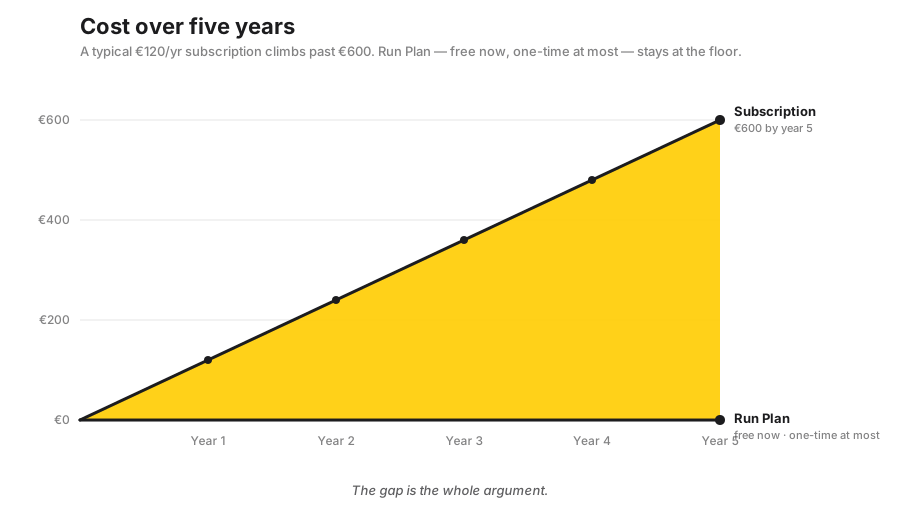
And whatever we might charge for later, the runners who showed up early will not wake up behind a new paywall. You took a chance on us, and that is worth more to us than the revenue we are choosing not to chase yet.
The apps that prove it works
One-time pricing is not nostalgia; indie apps have run on it for years. Workoutdoors and HealthFit both sell for around €5, once, and sustain real businesses. AutoSleep has been a profitable one-person app for the better part of a decade. PCalc has funded its author for fifteen years on a single purchase. Smaller businesses than Strava or Runna, on purpose.
The objections, and our answers
Servers cost money. We do not have any. Everything runs on the device, through HealthKit and the system frameworks. Our running cost is an Apple developer account and a domain — about €110 a year — which we can carry indefinitely. Not having infrastructure turns out to be the cheapest infrastructure.
Without a subscription you cannot keep developing the app. For now we do not need to charge at all. If we ever do need revenue, the bet is that one-time purchases cover it. And if we are wrong and stop, everyone keeps the version they have: the plans do not expire, because there is no server to switch off.
People prefer predictable monthly pricing. Some do. For running apps, most do not — the price is the single most common complaint in Runna’s reviews, and the complaint is rarely “this app is bad.” It is “this app is good, but €120 a year is too much for what I need.”
It is a small price for a coach in your pocket. It would be, if these apps were coaches. They are algorithmic plan generators with marketing that says “personal coach.” A real coach is €100 to €300 a month, and worth it for serious athletes. The middle ground these apps occupy — more than a static plan, far less than a coach — is a created market, not an inherent one.
What this commits us to
No subscription tier, ever — not even a “premium” one; we would ship a different app first. No countdown timers and no win-back emails. And no data to extract, sell or license, because it never leaves your device. If we ever do charge, we will show the price plainly, support Family Sharing so couples training together do not pay twice, and tell people well in advance — no surprises.
There is a real market of runners who want to own what they paid for, keep their training private, and use an app that does not quietly get worse over time. That is a smaller business than Runna, and we accept it. Subscriptions are a fine model for a lot of companies. They are not the one we are building.
If you have read this far, you are probably already the kind of person this is for. Thanks for being early.
Run Plan is an indie iOS + Apple Watch training planner built by a 2-person team in Amsterdam. No accounts, no ads, no subscription — every plan is free for now. Your data stays on your device.