
By Dan & Katya · April 19, 2026
Why Training Plans Are Interesting
Anyone can find a marathon training plan in ten seconds. Google returns ten thousand of them. ChatGPT will draft one in three sentences. Most fitness apps generate one on a tap.
Most of these aren’t very good. Not because the people who wrote them were lazy — because a real training plan is doing several things at once, and all of them have to be coordinated. If any of them is off, the whole thing collapses into something that looks like training and doesn’t function as training.
We’ve spent two years inside the problem and like it more now than when we started. This is what’s actually going on inside a plan, and what made us spend those years building one app’s worth of plan generation rather than fifteen minutes prompting an LLM.
What a plan actually is
A list of workouts is not a plan. The list might be the same list a plan would produce, but without coordination it’s a checklist, not a structure.
Underneath the visible surface — workout names, days of the week, pace numbers — every reasonable plan is doing three things in parallel.
Phases
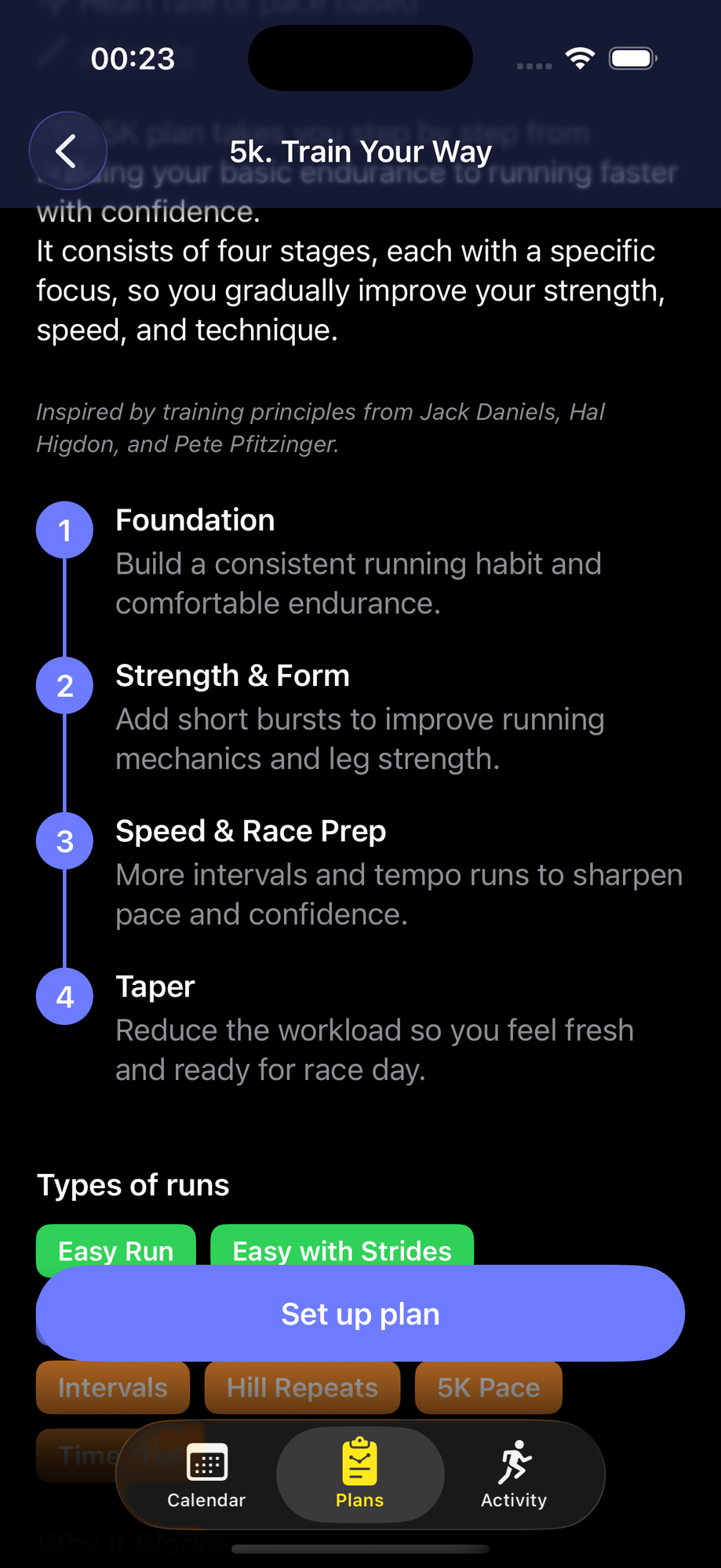
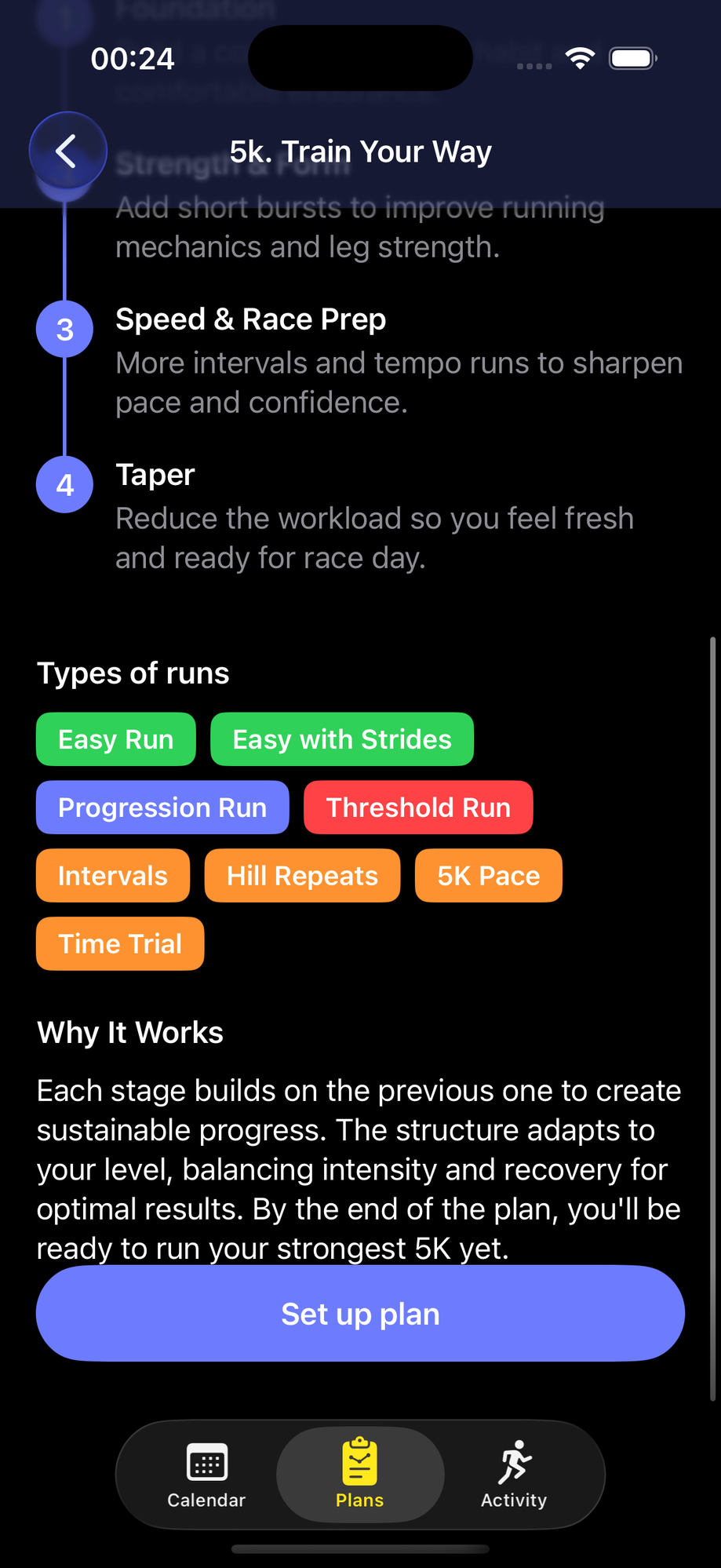
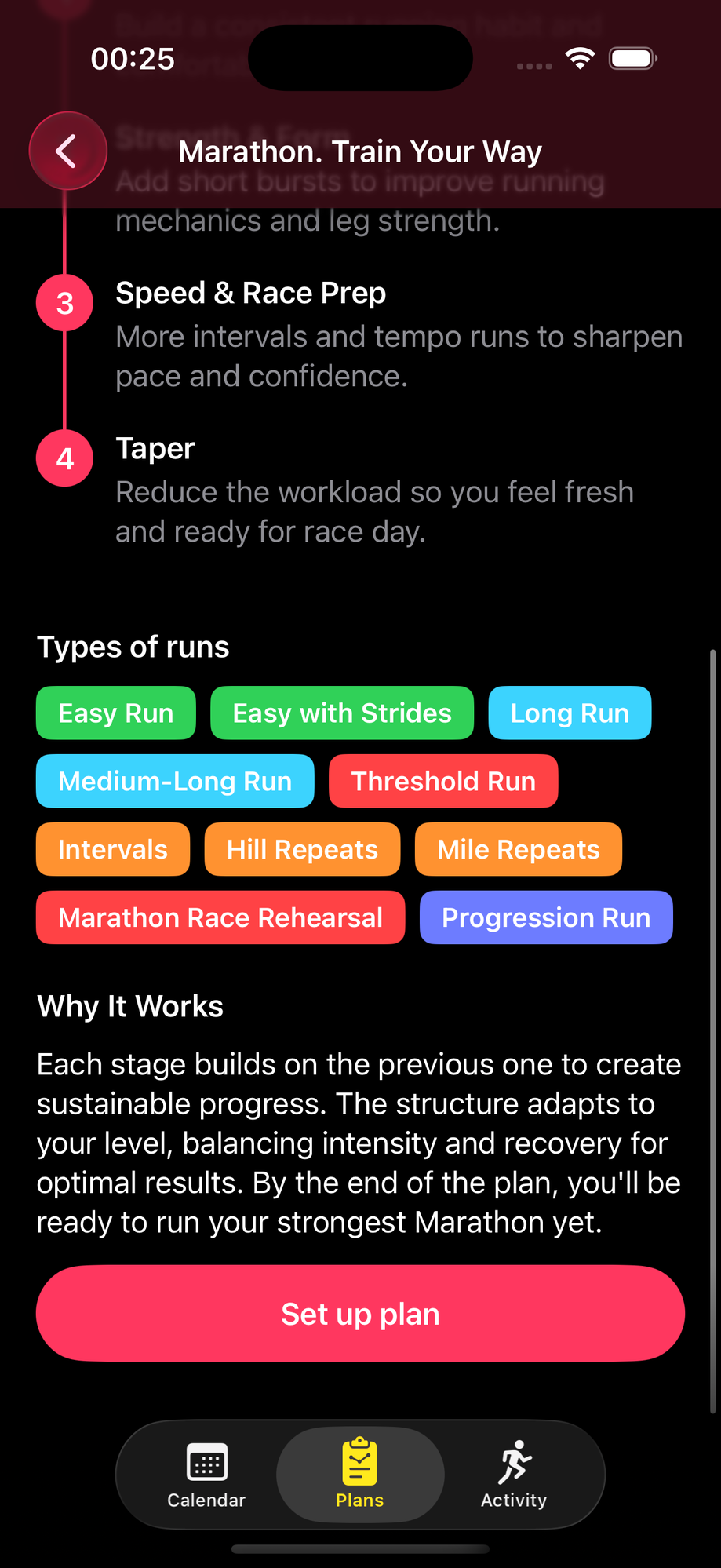
The plan moves through distinct biological goals: aerobic foundation, speed development, race-specific fitness, sharpening taper. Each phase has different workout selection and total load. Skipping or compressing one doesn’t shorten the plan; it breaks it.
Progressive load
Weekly stress climbs, plateaus or drops for a recovery week, then climbs again. The body adapts during recovery, not during the load. The progression band varies by tier — Higdon novice plans build long-run mileage in larger weekly jumps but cap weekly volume early; Pfitzinger marathon plans build at six to ten percent a week, both with structured deloads.
Workout variety with intent
Easy, threshold, interval, long, race-pace — each type targets specific adaptations, and the plan has to cycle through them in the right ratios.
Most generated plans fail on the structure. Workouts on days, varied names, plausible pace numbers, no scaffolding underneath. The easy:hard ratio drifts. Progression is flat or random. Race-pace work doesn’t show up in the right phase. The runner does the work and doesn’t get fitter, and nobody can quite say why.
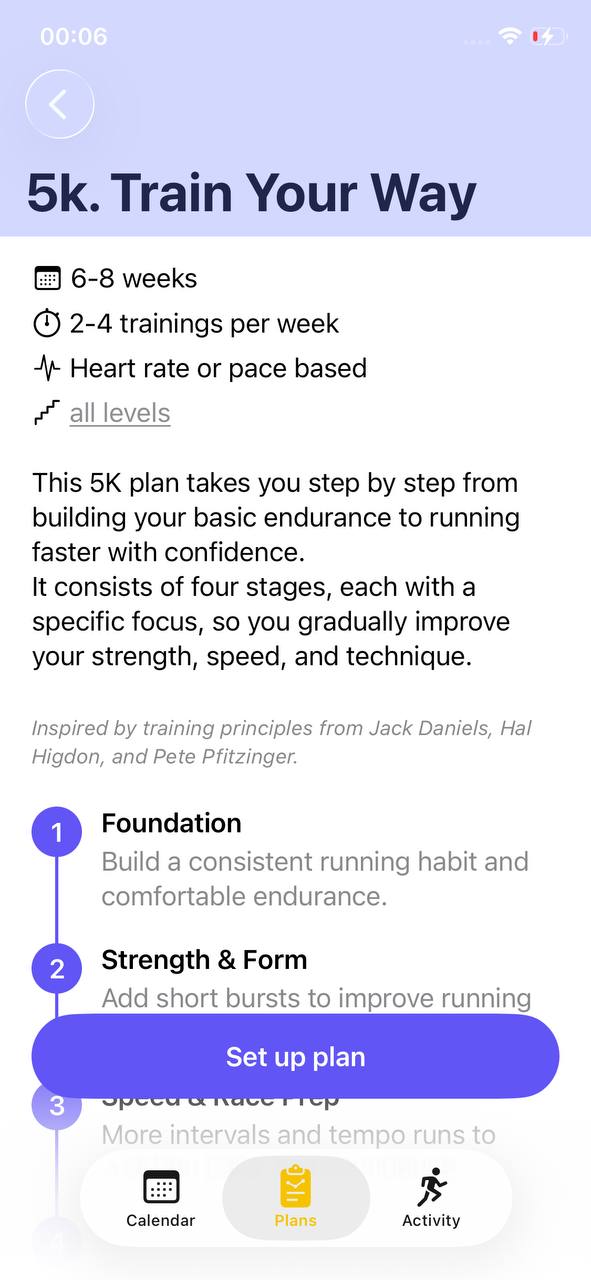
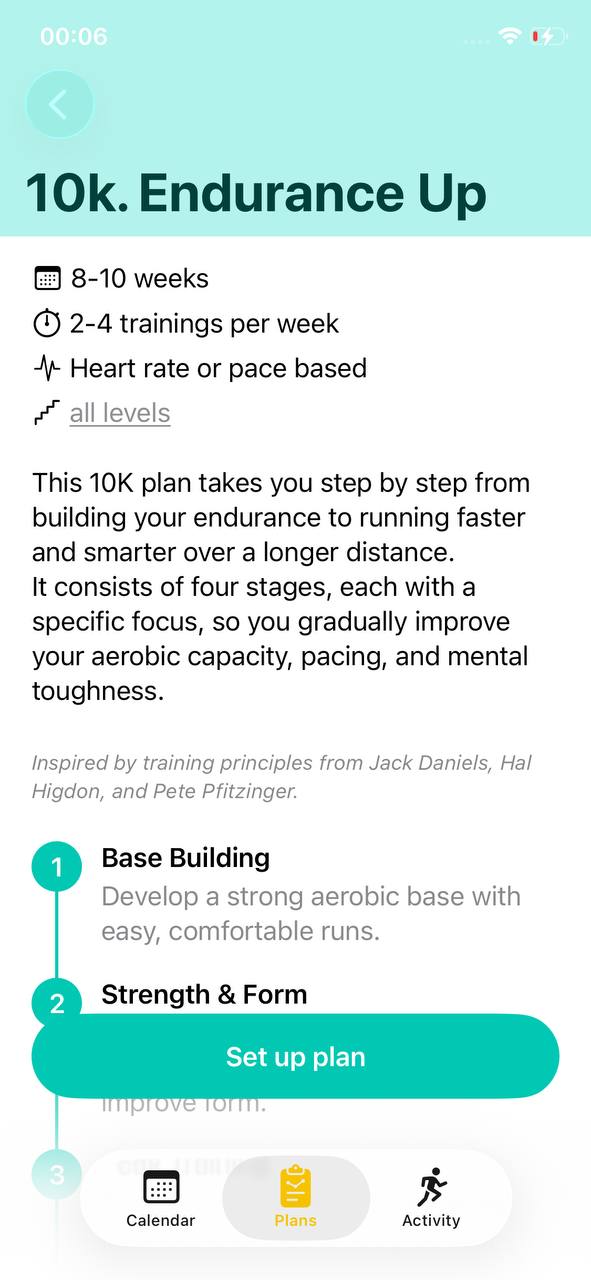
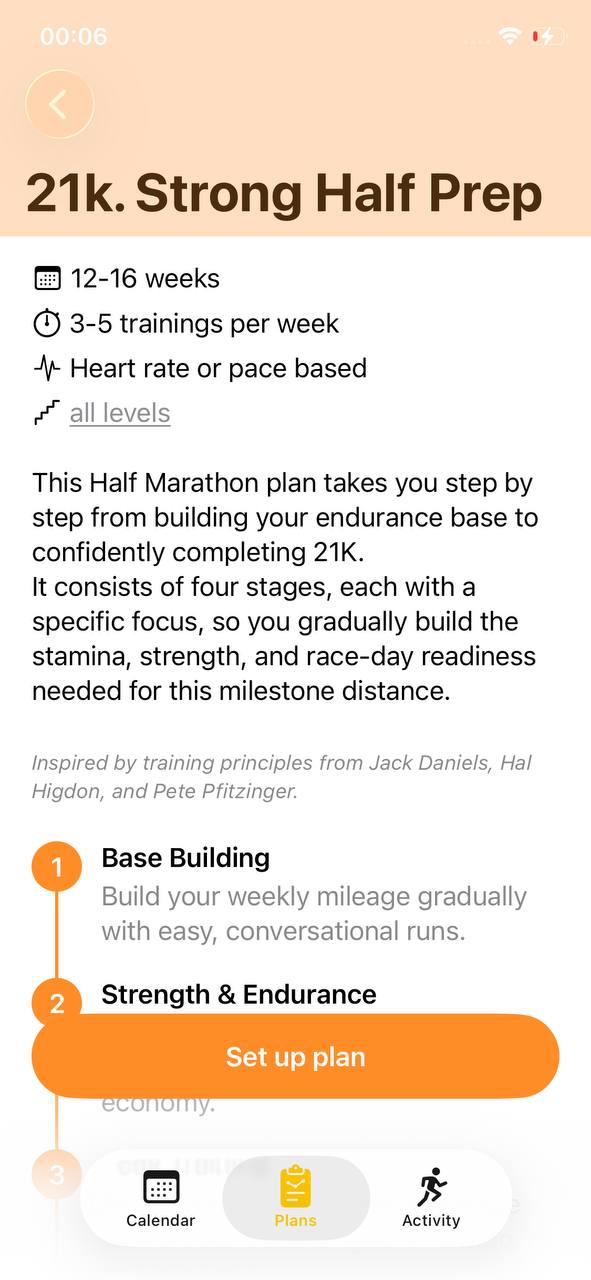
What each workout type does in the body
Easy runs build the aerobic base. Conversational pace, heart rate in zone 2, almost too easy. That’s the point. Aerobic mitochondrial enzyme activity can roughly double in the first six to twelve weeks of consistent training in a previously untrained runner; total mitochondrial volume density climbs 40–50%. Capillary density climbs the same range. Plasma volume expands, stroke volume rises, resting heart rate falls. None of it happens in a single run. It accumulates.
Stephen Seiler’s 80/20 framework — eighty percent easy, twenty percent hard, popularised by Daniels — comes from observing elite endurance athletes who skew this way and run faster races for it.
Threshold runs raise the lactate threshold. Pace is “comfortably hard”, holdable for about an hour at race effort; sessions run twenty to forty minutes. MCT transporters — the molecules that shuttle lactate out of muscle fibres — get upregulated; the pace at which lactate starts to accumulate shifts faster over weeks of work. Done well, it’s the most cost-effective adaptation per session.
Intervals build V̇O₂ max — the maximum rate at which the body can transport and use oxygen. Short, hard, repeated. Four hundred to sixteen hundred metres at roughly 5K race pace with short recoveries. Stroke volume peaks higher than at any other intensity, training the cardiac muscle directly. One session a week through the build, maybe two in peak. More than that, the runner doesn’t recover; they dig a hole.
Long runs build endurance — ninety minutes to three hours at mostly easy pace. The body learns to burn fat earlier and reserve glycogen for late in the race. Mental endurance — the capacity to maintain effort against fatigue signals — adapts measurably. Connective tissue (tendons, ligaments, fascia) gets stronger, and this is the slowest-adapting tissue in the body, the one most likely to break if volume ramps too fast. Cut the long run and the plan stops being a marathon plan.
Race-pace work is the specificity principle in action. The closer to race day, the more training should look like race day; the neuromuscular system learns the specific velocity the race will require. For a marathon: race rehearsals (long runs with sixty to ninety minutes embedded at MP), MP tempos, Yasso 800s. Yasso’s claim that average 800 time predicts marathon finish is folklore that doesn’t survive statistical scrutiny, but the workout itself is honest VO2 work.
The phases
A typical marathon plan moves through four phases.
| Phase | Goal | Workout emphasis |
|---|---|---|
| BASE | Aerobic foundation | Easy runs, long run, maybe one introductory quality |
| SPEED | Add intensity, raise threshold | Intervals, threshold, one MP segment |
| PEAK | Race-specific fitness | Three quality sessions, race rehearsals, peak mileage |
| TAPER | Sharpen, shed fatigue | Volume drops 30-50%, intensity holds |
Inside each phase, weekly load goes up roughly six to ten percent for three weeks, then drops fifteen percent for a recovery week, then climbs again. The classic 3:1 build-to-recovery ratio. The body adapts during the recovery week, when the previous three weeks’ load converts into fitness. Skipping the recovery is the single most common amateur mistake.
The transitions are where most generated plans break runners. A plan that snaps from “all easy” to “three quality sessions per week” in one week is a common failure mode. We feather: the last BASE week contains one introductory quality session, the last SPEED week contains one MP segment in the long run, the first TAPER reduces volume gently. The body is never asked to handle a workout type cold.
Within a single week
The week is shaped around quality-day spacing. Two or three quality sessions, separated by at least 48 hours. The long run anchors the weekend. Recovery runs in between.
We never put two hard days back-to-back. We never put a hard day the day after a long run. If race week or holidays force a conflict, we move the easy days, not the quality ones.
The medium-long run sits midweek, sixty to ninety minutes at easy pace. It anchors the aerobic side without overflowing into the next quality session. Strides — eight by twenty seconds at fast pace, full recovery — show up the day before quality sessions or before a long run, to wake the neuromuscular system without recovery cost.
Across the whole plan
The long run climbs through the build weeks and dips on the recovery weeks — about twenty percent shorter every third week, on purpose, then back to climbing. The rule the engine enforces is that the climb itself never stalls: outside those scheduled dips, no week has a shorter long run than the week before. That sounds obvious. It catches the most generation errors.
Quality-session count escalates by phase: one per week in BASE, two in SPEED, three in PEAK. The catalogue rotates workout types within the quality slots — no specific hard session (Yasso 800s, mile repeats, threshold cruise, MP rehearsal) repeats inside a three-week window. The runner sees variety while the load curve and the phase emphasis are entirely deliberate.
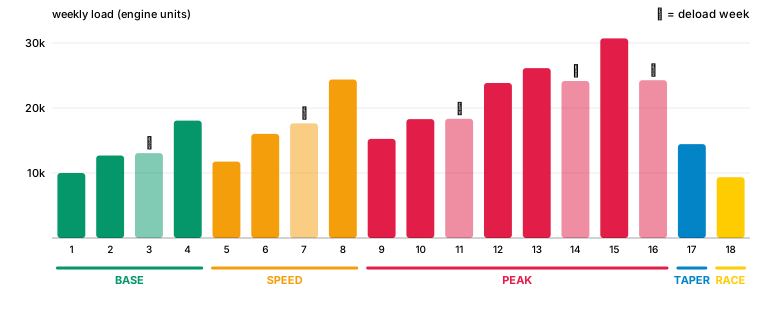
If the runner has more weeks until race day than the structured build needs, the surplus goes into BASE — pure aerobic, no quality, slowly rising volume. Mitochondrial density, capillary growth, slow-twitch durability all benefit from sustained easy mileage in a way that quality sessions don’t. By the time SPEED starts, the runner has a deeper foundation and the quality work hits a more resilient body.
Why progression isn’t linear
A complete beginner pulls their VDOT (Daniels’ one-number fitness score) from 28 to 33 in six weeks of consistent first-time training — twenty percent more aerobic capacity, several minutes faster across every distance. A sub-3:00 marathoner working through eighteen weeks of disciplined Pfitzinger 18/70 is delighted with two VDOT points.
Physiology. Untrained-to-trained adaptations are big and come quickly; mitochondrial enzyme activity that nearly doubled in the first three months stops jumping once it’s already established. Each cycle extracts less from the same input. Pulling VDOT 50 to 53 is a year for most amateurs; 60 to 63 is multi-year work for serious club runners. There’s a practical ceiling — around VDOT 80–85 for elite men, 75–80 for elite women — and the closer the runner sits, the harder each point. Most amateurs never get close. They hit a personal ceiling set by available training time, sleep, life stress, and genetics, and plateau there.
The plan’s job is to extract as much fitness per cycle as the runner has room for. The job isn’t to promise the ceiling.
Plateaus runners hit
Volume plateau — once a runner is at sixty to seventy miles per week, pushing to ninety doesn’t reliably produce faster race times. Injury risk rises faster than fitness gain. Most amateur runners cap out around sixty-five to seventy-five mpw of useful training. Only elites with full-time training infrastructure benefit from one hundred plus.
Quality plateau — three quality sessions per week is the sustainable ceiling for almost all amateur runners. A fourth introduces enough cumulative fatigue that the other three get worse, and the long run loses its quality.
Pace-targeting plateau — race-pace work teaches the body to hold the pace, but only up to a point. After about six weeks of marathon-pace segments, the neuromuscular adaptation is largely banked. Additional MP runs stop adding much; rotation between delivery patterns (rehearsals in long runs, standalone tempos, progressive long runs finishing at MP) extracts more than repetition.
Across a multi-cycle career — plan to plan to plan — the runner climbs through successive plateaus. Each cycle extracts the available fitness given the runner’s current state; the next works from a higher base. A first-time marathoner running 4:30 might drop to 4:10 in the second cycle, 3:55 in the third. A sub-3:30 runner targeting sub-3:00 typically takes two or three cycles. Between cycles is when adaptation consolidates — the two to four weeks of recovery after a race aren’t training, they’re how the just-built fitness gets banked.
HR or pace
Every workout in the app runs in one of two modes. HR-based — each interval has a target heart rate zone (Z1-Z5). The Watch shows a live indicator: green in zone, yellow close, red working too hard or too easy. Pace-based — each interval has a target pace, computed from the runner’s current fitness estimate through Daniels’ tables, with our own calibration adjustments.
HR is better for runners new to structured training, runners working in heat or hills or altitude where effort and pace diverge, and runners whose Apple Watch HR is reliable on their wrist. Pace is better for runners with specific time goals, runners on tracks or flat roads, and runners who find a specific number clearer than a zone label. Most users start HR-based and switch to pace as their goals tighten.
Why we built this
Training plan design is an interesting problem in the way puzzles are interesting. Constraints — biology, time, recovery capacity, injury risk, race date, the runner’s life. A goal — a specific fitness on a specific day. A catalogue of tools with known physiological effects. The job is composing the tools into a sequence that maximises the goal given the constraints. Part biology, part scheduling, part dynamic systems (the recovery curve is real and lagged), part feel. Every great coach has a different opinion on the right knobs and they’re all defensible.
When we audit a generated plan and notice the engine picked a long progression run exactly where Higdon would have prescribed one — without us writing a rule that says so — the math has agreed with the human intuition and the runner gets the right run. The app is the surface. The plan engine is the surface of the surface. The thing underneath keeps being interesting.
Further reading
- Jack Daniels, Daniels’ Running Formula. The reference for VDOT, training paces, the 80/20 split. Calculator here.
- Pete Pfitzinger & Scott Douglas, Advanced Marathoning. The reference for marathon phase structures and race-pace integration. Training site.
- Hal Higdon’s training programs. The reference for the beginner-friendly end of the spectrum. We compare against these constantly.
- Joe Friel, The Triathlete’s Training Bible. Load-based prescription. We borrowed the math.
- Steve Magness, The Science of Running. Running physiology without the airbrushing common to popular fitness writing.
- Tudor Bompa, Periodization Training for Sports. The textbook on periodization theory.