
By Dan · May 10, 2026
Training for the Uphill Athlete: A Book About Mountains That’s About to Rewrite Our Engine
We just finished a book that’s going to change how Run Plan generates plans. It’s not Daniels’ Running Formula. Not Higdon’s marathon books. Both of which we explicitly cite.
It’s a book about mountaineering.
Training for the Uphill Athlete
Steve House, Scott Johnston, Kílian Jornet, 2019.
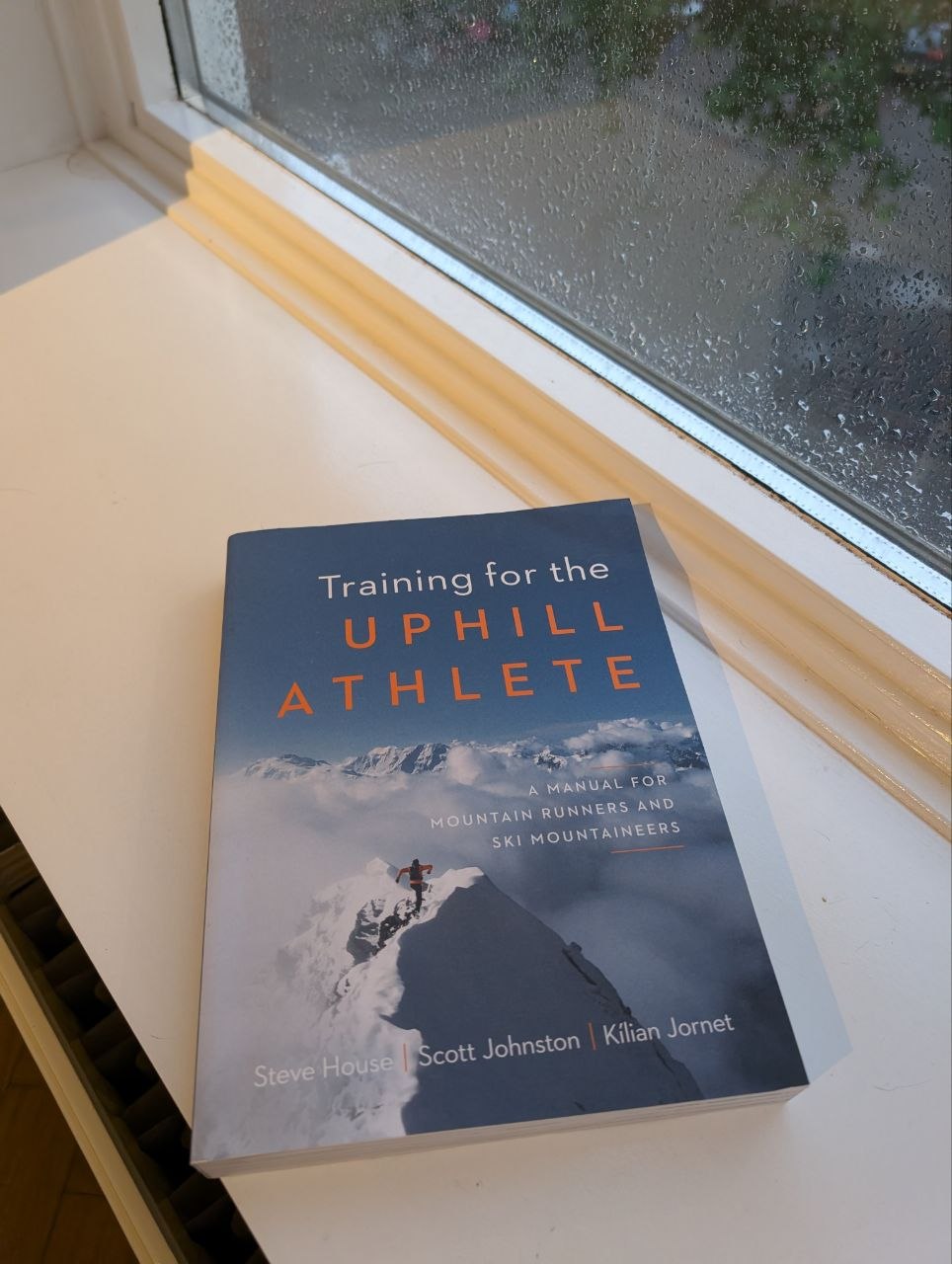
This is the writeup of why a book on mountain ultras and ski mountaineering is about to reshape a road-running app’s plan engine — and what that book teaches that the popular road-running literature largely misses.
The book in one sentence
If road-running training literature (Daniels, Higdon, Pfitzinger) is about how to get faster over a fixed distance, Training for the Uphill Athlete is about how to build a body that can move efficiently for very long durations under repeated submaximal stress.
The mountaineering context (alpine climbing, ski touring, ultras, mountain running) requires a different physiological profile than 5K-to-marathon road racing:
- Multi-day events instead of one-day races.
- Climbs measured in vertical meters, not just horizontal distance.
- Effort at altitude with less recovery time.
- Lower-intensity, higher-volume training year-round.
- Multi-year athletic development horizons (not 16-week blocks).
The book’s training philosophy emerges from those constraints. And once you’ve read it, you realize a surprising amount of what it teaches applies to road running too — just with different emphasis.
How we ended up reading it
Late March. The catalog audit we’d been planning was supposed to start that weekend. We had a vague sense the engine was producing plans that technically followed periodization but felt off in a way we couldn’t name. Around the same time we’d been watching the YouTube channel of the trail-running couple Jeff Pelletier and Audrey Lafrenière — they brought up this book in passing. We grabbed it for evening reading.
By chapter three we were taking notes in the margins. By chapter five we were rewriting our easy-run logic in our heads. The kind of slow read that sticks.
Five specific ideas from the book are about to reshape what we ship.
1. Aerobic base is everything
The book’s central claim, summarized brutally:
The aerobic system is the single most important determinant of endurance performance, and most amateur athletes severely undertrain it.
At long durations (anything over ~90 minutes), the body runs on fat oxidation. The capacity to oxidize fat at progressively higher intensities is what separates a runner who blows up at mile 18 of a marathon from one who finishes strong. And fat oxidation capacity is built almost entirely through Zone 1-2 training at very high volume.
Not new science — consensus of endurance coaching for fifty years. But it gets diluted in popular running literature, which often emphasizes intervals at the expense of base volume.
What this is about to change in Run Plan: our BASE phase is currently ~25% of plan duration. We think it needs to be longer — closer to 30%+ for beginner marathon plans. And the easy-run pool in our catalog is much thinner than it should be (the audit will tell us how thin). The book is the reason we’re making BASE longer, not just a vague feeling.
2. Polarized training, not threshold-heavy
The book heavily emphasizes the polarized training model: roughly 80% easy (Zone 1-2) and 20% very hard (Zone 4-5), with very little in the muddy middle (Zone 3, “tempo” or “threshold” pace).
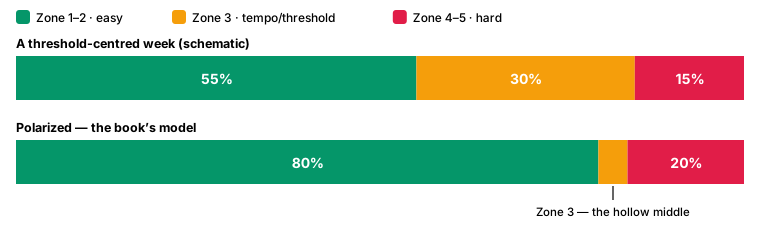
The case against threshold pace as the primary stimulus is interesting:
- Hard enough to require significant recovery (you can’t do it every day).
- Not hard enough to maximally stimulate the very-fast adaptations (VO2 max, anaerobic capacity).
- Compromises the very-easy training (Zone 2) by leaving you too fatigued to do it well.
- “Comfortable hard” — feels productive, produces less adaptation than either easier OR harder work.
The recommendation: keep the easy truly easy. When you go hard, go hard enough to actually trigger high-intensity adaptations.
What this is about to change in Run Plan: our easy-run zone targets are currently Zone 2 across the board. We’re going to introduce Zone 1 variants (genuinely recovery-easy, post-quality-day) so the easy/hard polarization sharpens. And we’re going to schedule threshold work less aggressively — once every 7-10 days at most, instead of nearly every week.
3. Long-term development, not short-term peaking
The book is explicitly multi-year. The training philosophy assumes you’re improving over 3-5 year horizons, not one race cycle. Year 1 builds aerobic base. Year 2 adds intensity. Year 3 starts producing real race performances.
Hard for a road-running app to act on directly — users come to us with a specific upcoming race, not a five-year plan. But it reshapes something subtler: our marathon plans need to acknowledge that a first marathon is a long-term project, where most of the work happens over years, not weeks.
The maintenance plan we offer between race cycles is more important than it looks. Most apps treat “between races” as filler. We want to treat it as the period where actual fitness gains happen, with race cycles being the harvest, not the construction.
We’re also rethinking plan creation to ask about prior training experience more carefully. A runner with two years of consistent running should get different plans than someone in their first four months — even if both target the same race in the same number of weeks.
4. Hills and strength are aerobic tools too
The book treats hill running and strength training not as separate from aerobic development but as integrated aerobic tools. A long uphill walk-jog session is aerobic training that also builds the leg strength and economy that make you faster downhill.
In our current engine, hill workouts are positioned as “speed work on hills” — quick anaerobic efforts at hard intensity. The book reframes this. We’re going to split hill workouts into two flavors:
- Aerobic hill work — sustained climbing at Zone 2-3 effort. Builds leg strength AND aerobic capacity. Goes in BASE.
- Hill repeats for speed — short hard efforts, Zone 4-5. Goes in SPEED/PEAK.
Beginner plans will lean toward the first. Advanced plans will keep both. Mountain ultra runners would recognize both as legitimate. Road-running apps usually only ship the second.
5. The middle distance matters: medium-long runs
For mountain runners, the “long run” isn’t a single weekly outing — it’s a regular cadence of multi-hour efforts spread across the week. A typical training week might include:
- Three Zone 2 runs of 60-90 minutes (medium-long).
- One Zone 2-3 long run of 2-4 hours.
- One harder session (intervals or hill repeats).
- Recovery days.
Compare to typical road running plans:
- 3-4 weekly runs of 30-60 minutes (variable intensity).
- One long run of 90-180 minutes.
- Optional hill or interval work.
The mountain approach is more aerobic-volume-heavy. The road approach is more intensity-distributed.
For longer road events (half-marathon and especially marathon), the mountain approach is arguably better. A marathon is ~3-5 hours of continuous Zone 2 effort. Training that consistently includes multi-hour Zone 2 outings prepares you for it more directly than training that emphasizes shorter, more variable efforts.
What this is about to change in Run Plan: we want to add “mid-week medium-long” runs to intermediate and advanced half-marathon and marathon plans. 60-90 minute easy runs scheduled mid-week, between quality workouts and the weekend long run. Aerobic-volume-builders, not speed work. The runner’s weekly volume goes up. The stimulus shifts.
The current shape of an intermediate marathon week:
Mon: rest
Tue: speed work
Wed: easy 40 min
Thu: rest
Fri: easy 45 min
Sat: long run
Sun: rest
What we want it to be:
Mon: rest
Tue: speed work
Wed: easy 75 min   ← the new medium-long
Thu: rest
Fri: easy 45 min
Sat: long run
Sun: rest
Same number of runs.
What the book doesn’t say (that we’ll use anyway)
Worth noting: the book is about ultra and mountain training. Some of its prescriptions don’t apply cleanly to road running:
- The book’s “long run” is 4-6 hours for ultra prep. Most road marathoners can’t and shouldn’t do 4-hour long runs.
- The book emphasizes vertical meters in addition to distance. Most road runners don’t track or care about elevation.
- The book recommends specific ultra-prep workouts (back-to-back long days) that have no road-running equivalent.
We’re translating the philosophy without copying the specifics.
Why a road-running app cares about a mountain training book
Two reasons.
One. Most road-running coaching literature, especially the popular books, undertrains aerobic base — not a fringe opinion but the modern consensus of elite endurance coaches, and this book makes the case more clearly than any other we’ve read.
Two. The book is about mountain athletes, but the underlying physiology is the same. A 3:30 road marathon is a 3.5-hour Zone 2 effort. So is a 25 km mountain trail run with 1000 m of vert. The body doesn’t know which one it’s doing. The aerobic system either has the capacity or it doesn’t.
What changes between mountain and road is the specific work (more strength for hills, more pace specificity for road) and the durations (multi-day for ultra, single-day for marathon). The aerobic foundation is identical.
What changes next
This is a book post, not a release post. But the to-do list, while we have it open in front of us:
- BASE phase ratio bump for beginner marathon (~25% → ~30%+).
- Easy-run catalog expansion (currently very thin — we need many more templates, varied durations, varied target zones).
- Threshold work spaced more (every 7-10 days, not every week).
- Hill workouts split into aerobic vs anaerobic flavors.
- Mid-week medium-long run inserted for intermediate+ half and marathon plans.
- Maintenance plan reframed as the base-building period, not filler.
We’ll write up the actual engine changes once they ship. The audit we’re about to do will probably reveal more we need to fix.
Who should read this
- Runners training for half-marathon or marathon who feel their plans are missing something.
- Runners who’ve tried interval-heavy plans and ended up injured or burned out.
- Older runners (40+), where aerobic-base-heavy training extends athletic longevity.
- App builders: read both this and Higdon. Build the simpler interface. Encode the deeper philosophy underneath.
The shortlist
Building software as a small team means you can’t read everything. The constraint forces you to pick a few sources and go deep. Run Plan’s:
- Jack Daniels — Running Formula (zones, intensities, pace math).
- Hal Higdon — Training Programs (volume reference, beginner-friendly structures).
- Pete Pfitzinger — Advanced Marathoning (mid-week medium-long, intermediate/advanced volume).
- Steve House, Scott Johnston & Kílian Jornet — Training for the Uphill Athlete (aerobic philosophy, polarized intensity).
If you’re building anything in endurance training tech, Training for the Uphill Athlete belongs on the short list.
Further reading
- The book — Training for the Uphill Athlete (Patagonia Books, 2019).
- The Architecture Story — the engine these ideas are about to land in.
Run Plan is an indie iOS + Apple Watch training planner built by a 2-person team in Amsterdam. No accounts, no ads, no subscription. Your data stays on your device.