
By Dan · June 12, 2026
A Year Is Not One Plan
Most people who download a running app are thinking about one race. A 10K in the autumn, a first marathon in spring, a 5K someone talked them into. They pick a plan, follow it for twelve or sixteen weeks, run the race — and then nothing. The plan ends at the finish line. A few weeks later they start another one from roughly where they began.
That works. It is also the slow way to get fit. The runners who improve year over year are not running better single plans; they are running better years. The unit that matters is not the race and not the plan. It is the season, and a season is made of cycles.
This is not our idea. It is the oldest idea in endurance coaching, and most generated training apps quietly ignore it because it does not fit inside a single twelve-week download. Here is the shape of it.
A year is a staircase
A cycle is a block of training built toward one race: a base, a build, a peak, a taper, the race. That is exactly the structure RunPlan already puts inside a single plan — the phases, the progressive load, the recovery weeks. The new idea is simply that you do not stop after one. You take a short rest, and then you start the next cycle from the fitness you kept.
Each cycle’s peak is a little higher than the last. Each rest gives a little back — but not all of it. Drawn over a year, the line is not one hill. It is a staircase.
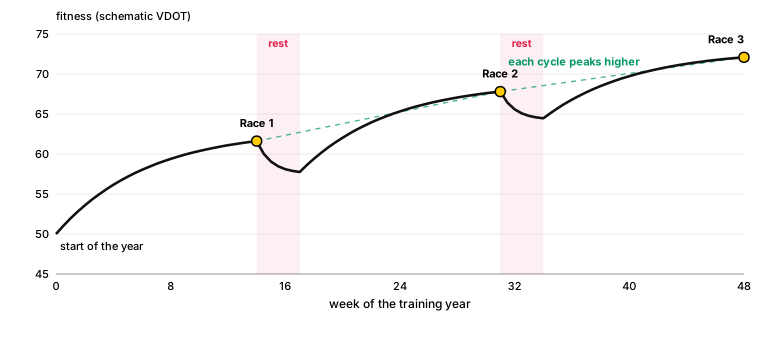
Arthur Lydiard built his runners this way in the 1960s — in annual seasons, not in single build-ups. Tudor Bompa’s periodization gave the nested cycles their names: the macrocycle is the season, the mesocycle is a block of a few weeks, the microcycle is a single week. The reason the staircase climbs at all is supercompensation: stress the body, let it recover, and it rebuilds slightly above where it started. That happens at the scale of one hard week. It also happens at the scale of a whole cycle, which is why the rests between races are part of the climb and not a break from it.
Why not just train straight through?
The obvious objection: if I want to be as fit as possible for my goal marathon, why break the year up at all? Why not train hard for six months straight and arrive at one enormous peak?
Because you cannot hold a peak. Sharpness — the very top of your range — lasts a few weeks, not a few months. Train unbroken toward a single far-off date and you either peak too early and fade before the start line, or never quite peak and arrive flat. And six months of hard training with no race to interrupt it is one of the more reliable ways to get injured or stale. Three shorter cycles, each broken by a real race, finish the year fitter than one long grind — and you got to race three times instead of once.
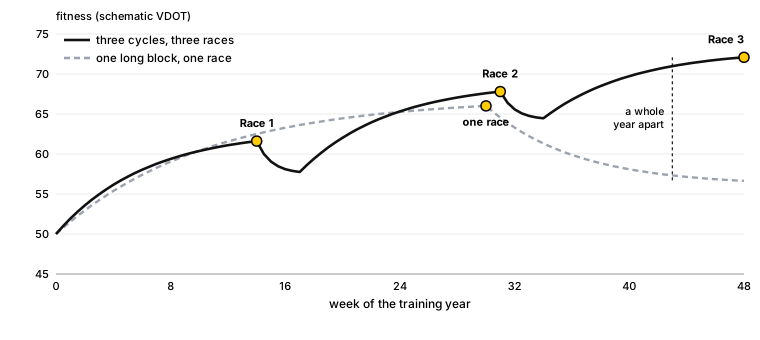
One honest exception: a true beginner training for a first marathon may genuinely need a single long, uninterrupted build, because the goal itself is the adaptation. The cycling argument is for the year after that — and every year after that.
The rest is the part everyone skips
Between cycles sits a recovery block. The textbooks call it the transition phase, and it is short: two to four weeks of reduced load. Easy running, cross-training, no goal pace, much less structure. It is not time off. It is lighter time, and it is the bridge from one cycle to the next.
People skip it because resting feels like losing fitness, and for a few days it looks that way on the watch. The staircase is the rebuttal: the dip is small, and the next cycle starts higher because of the rest, not in spite of it. Skip it cycle after cycle and the season stops being a staircase and becomes a plateau with a cold or a stress fracture on top. The single most common mistake we see is not too little training. It is no off-ramp between the hard blocks.
Not every race is your goal race
If a year has several races, they cannot all be the race. Joe Friel’s system is the cleanest way to say this: rank them A, B, and C.
- An A race is the one a cycle is built around. Full taper, everything pointed at it. One, maybe two in a year.
- A B race is a hard effort you run through with at most a small cutback — no full taper. A fitness check inside the cycle.
- A C race is a workout with a number on it: a parkrun, a tune-up, a rust-buster three weeks out. You do not rest for it; you race it tired.
Treating every race on the calendar as an A race — tapering for each, emptying the tank at each — is its own quiet way to overtrain. Most of the dots on a good year’s calendar are B and C.
This is true at every level
None of this depends on being fast. It does not matter whether the races are sub-3 marathons or a couch-to-5K graduate’s first parkrun. The shape is the same. What changes is the axis.
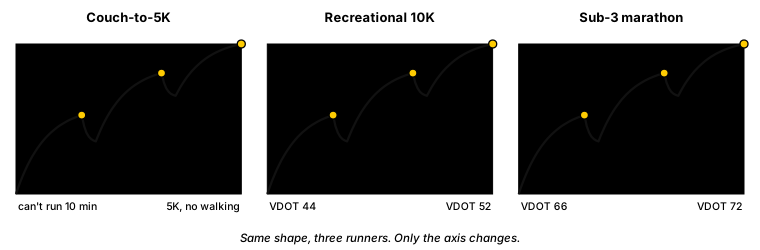
The beginner’s staircase is steeper, because the body adapts quickly when it is far from its ceiling — the first year of consistent training is the largest jump most runners ever make. The elite’s staircase is shallow, because Bompa’s adaptation curve flattens as you approach your limit. But it still climbs, and near the top the rest blocks matter more, not less. Everyone is running the same staircase. They are just standing on different steps.
Where RunPlan fits
RunPlan builds one cycle at a time. You give it a race and a date, it builds the block from base to taper, and that is one step of the staircase. It also builds maintenance blocks for the flat stretches between races, when you want to hold fitness without pointing at anything.
What it does not do yet is hold the whole year. It will not, today, lay out three cycles and two rest blocks across a season and keep the staircase rising on its own. You assemble that by hand: finish a plan, take the recovery block, start the next plan a little fitter than you started the last. The annual view — the app reasoning about the year instead of the plan — is the thing we most want to build next, precisely because the year is the real unit and the app still mostly thinks in plans.
So the next time you finish a plan, the interesting question is not only whether you hit the time. It is what the next cycle starts from, and whether you will rest enough to start it higher.
Further reading
If you want to go further than one app screen, this is the literature, in roughly the order it would matter to a curious runner.
- Arthur Lydiard & Garth Gilmour, Running with Lydiard. The original case for building a runner across a season rather than a single build-up — base first, everything else after. The Lydiard Foundation, run by his former athletes, keeps the method going.
- Tudor Bompa, Periodization: Theory and Methodology of Training. The textbook that names the macro/meso/micro cycles and the transition phase, and treats supercompensation and the adaptation curve the staircase is drawn from. TrainingPeaks has a readable summary of the three cycles.
- Joe Friel, The Triathlete’s Training Bible. The cleanest treatment of the annual training plan and the A/B/C race-priority system used above. The framework is sport-agnostic even though the book is not.
- Jack Daniels, Daniels’ Running Formula. The reference for the phases inside a cycle, and for why peak sharpness is transient — the reason you cannot hold one peak across a whole year.
- Pete Pfitzinger & Scott Douglas, Advanced Marathoning. Among other things, the practical case for back-to-back marathon cycles and the recovery that has to sit between them.
- Steve House & Scott Johnston, Training for the Uphill Athlete. The multi-year view — fitness built across years, not seasons. We wrote about what it is doing to our own engine.
- For the academic version, the open-access Sport Journal review of annual training plans covers the same structure with citations.